Unknown's avatar

About MG McShane

Nerd by day, blogger by night and mother of the teen 24/7. Having been whacked on the back by Fate earlier this year, I am self-employed, oddly thinking that leaving a permanent and pensionable position in the middle of a recession was an enlightened idea! Coaxing the teen to the dinner table has become a full time preoccupation. Along with the foods I use to lure her out, there are stories to be told and observations to be made about the preparation of food generally and the breaking of bread with those we care for (Teen in the Attic). And when I am not in a culinary mood, I proffer observations about stuff and nonsense (Middle Aged Teen).

The Rana Plaza disaster – a quagmire of considerations

On 24 April 2013, the Rana Plaza in Bangladesh collapsed. Described as the deadliest garment factory accident in history, it left 1,129 dead and nearly 2,500 people injured. Among the rubble were found the labelled garments of 29 well known manufacturers who were outsourcing production to this factory.

Outsourcing on this scale is big business. Of Bangladesh’s total exports, garments account for 78 per cent. Some 59 per cent of these exports is destined for the European market. In Ireland, for example, CSO figures attribute €277 million of garment imports from Bangladesh since 2010. With big business in this context, however, comes little regulation and it is not surprising that it often results in corruption, collusion and most seriously, cutting corners for workers and workplace safety.

The Rana Plaza disaster is one among many but the scale means its victims are in need of immediate financial assistance. In reaction to this, the Rana Plaza Donors Trust Fund was established by the International Labour Organisation (ILO), an agency of the UN. The aim is to provide monies to those injured in the collapse and to those who have lost their principal breadwinner. Operating in contrast to a charity, the fund seeks to provide compensation to the most needy to spend as they see fit and not invested according to where the ILO deems appropriate.

So who funds the fund? While open to all, companies manufacturing in Rana Plaza are asked to contribute towards an overall goal of $40 million. Any contribution, it states, ‘does not imply legal responsibility or obligation for the accident’ and there is no onus on the company to disclose how much it has contributed.

Being included on the list of donors does not mean standing among equals. Of all companies, Primark has stepped up to the plate, contributing $8 million to the fund. It is also making contributions directly to workers which will be in the region of $4 million – a total of $12 million overall. It sits on the list beside companies such as C&A, Mango and Gap which made a contribution of $200,000 each. ‘Nearly all of these brands,’ states Clean Clothes Campaign Ireland (CCCI), ‘have failed to make a significant enough contribution and we are calling on them to increase their donations.’

On 4 July 2014, the fund stood at $17.7 million – substantially short of its $40 million goal. As donations dribble in, Matalan in the UK has come in for particular flak and attention. The last big British company to contribute, it only paid in the past few days. Susannah Compton, Campaigns Manager with ‘38 Degrees’ believes it did so after tens of thousands of people emailed, called and tweeted Matalan to tell them they could not walk away from their responsibilities. It chose not to disclose the amount contributed. Compton believes that ‘Until Matalan says exactly how much it has paid, its customers will still be waiting to see what kind of business it really is.’

Why did Matalan hold out this long? In its opinion, it didn’t. While it did not contribute to the ILO-managed fund until recently, it has already donated to BRAC, an NGO which will rehabilitate and retrain survivors of the Rana Plaza disaster (a similar approach to that taken by Benetton). Maintaining that it only ran a small pilot scheme from February to March 2013, Matalan states it had no interests there at the time of the factory collapse even if garments bearing one of its labels were found amongst the debris. It says it has donated the equivalent of what it made during this short time to BRAC. Calling for Matalan to contribute £3 million to the fund, the ‘Labour Behind the Label’ campaign group does not think duration is a relevant factor: “Quibbling over the exact status of an order at the time of a collapse is petty given the scale of the disaster.” There is no information, however, on how this amount was arrived at and why one company out of 29 should be obliged to contribute the equivalent of $5 million to a fund total of $40 million.

Paying into the fund is voluntary. While no company is forced to contribute, public and political pressure to do so is significant. But should all companies contribute equal amounts? There is no scale of contribution. David Babbs, executive director of ‘38 Degrees’ argues “If Primark can pay, why can’t Matalan?” Is this acceptable? Surely, a company which has benefitted most from the workers at Rana Plaza should contribute more than a company there momentarily? Morally, Matalan might contribute but from a business perspective, it makes little sense. With unsafe work practises throughout the region, there is the danger of setting a precedent that it might be required to contribute at the same level each time.

Matalan and many other companies, for example, Benetton, Walmart and the Gap Foundation, have opted, however, to contribute to BRAC. Why did Matalan pick this over the ILO fund? According to a company spokesperson, “In order to come to this decision, we have undertaken a significant level of due diligence and have moved to avoid public debates of where the right place to put our support should be.” Contributions to BRAC have been largely overlooked by the campaign groups which say that monies should be paid to the ILO fund specifically and have garnered public support to make this happen.

Should companies willing to contribute, however, not retain the right to place their money where they believe it can have most impact? As the largest NGO in the world, BRAC seeks to pull people out of poverty. It invests in communities’ own human and material resources, ‘catalysing lasting change and creating an ecosystem in which people who are poor have the chance to take control of their own lives.’ This is the approach being taken to those directly affected by the Rana Plaza disaster – seeking to arrange integrated livelihood options for people to ensure sustainable futures and to help them gain control of their own lives and those of their dependents. It seeks therefore to contribute to long-term goals rather than compensate short-term recovery.

Like Primark, Matalan was one of the main beneficiaries from the economic downturn and the demise of Woolworths in the UK. In all this discussion of which companies should pay and how much, little attention is given to the actual consumer who is creating, and sustaining, the demand for cheaper clothes. Companies manufacturing garments in Bangladesh and the surrounds are meeting that demand. An emphasis on higher standards and regulations will inevitably drive prices up. With the threat of increasing prices, companies can move elsewhere to less regulated areas to feed the demand for cut-price clothing. And so the cycle continues.

The Rana Plaza Donor Trust Fund is open to all but campaigns focusing on companies don’t promote this point. They simply highlight the cause without addressing the demand which perpetuates this practice. Saying this is not to divest companies of moral and financial duty to their workforce wherever they are located. Reading through all the materials on this subject, however, it makes one wonder how many of the writers, researchers and representatives are wearing clothes from the companies they now hold so culpable…

 Published online: 2014
Married Women and Short Hair – infinite mystery or new beginnings?


My daughter once asked: “Do women have to cut their hair when they get married?”

Honestly? I didn’t know what she was talking about. I knew some Jewish women cut their hair when married but, as for the average Irish woman, I simply had no idea. Over the years, I’d often heard derogatory remarks about women sporting long hair, how they should know better at their age “and they a married woman.” I dismissed such remarks, thinking little more about the subject.

It was my daughter’s question which got me thinking. I became increasingly aware of the hairstyle preferences of the married gal. I was surprised when I realised how many had indeed shortened their hair after marriage to the point of absolute horror when I learnt one lady cut her luscious locks a day into her honeymoon. And all this made me wonder where the ‘trend’ came from?

Many Jewish women cut their hair very soon after they marry so I wondered if, in Ireland, cutting married hair was some remnant of Judeo-Christianity? It’s common for women to shave off, or cut short, their hair and then cover their head – with a wig, scarf or shawl. It’s difficult to say where this custom actually comes from in the Jewish faith. The Talmud, for example, suggests that women’s hair exudes some form of sexual energy and to be modest is to remove it from view; doing so will save men from ‘unholy thoughts’. Others believe covering a woman’s head is a sign of a woman’s shame and guilt for the sin Eve committed; that her hair contributed to her temptation and seduction of man. And for Leila Leah Bonner, another explanation is that the Bible indicates that cutting off a woman’s hair often rendered her unattractive. In today’s world, however, it’s often seen simply as a symbol of transition from maidenhood to womanhood, from solitary life to married unity.

But this refers to women cutting their hair with the intention of covering it. Only the timeline for the act has any connection to Irish women today and their desire for shrinking hair length. It’s true, however, that long, luxurious, hair is often seen as symbolising strength, sensuality and passion. Relationship expert, Anjula Mutanda, believes it’s a ‘powerful symbol of femininity.’ Men are instinctively drawn to it, preferring it over the cropped alternative. According to Mutanda, if a man is given pictures of a woman with short hair and then with long hair, he opts for the latter; ‘his reaction is primeval.’ Shampoo ads use models with long hair, showing long locks oozing with sensuality. Depictions of washing short hair simply don’t have the same visual impact or consumer appeal.

If long hair contains all these wonderful properties and appeals more to men, why then do women continue to shorten their hair? Surely, it can’t be a case of “Now that I’m married, I can let myself go?” For Writer and Broadcaster, Fiona Looney, it seems that, once a woman had her man, there was no need for such frivolities. In a television programme for RTE, she said it was as if women were allowed to marry with long hair but then mysteriously returned from honeymoon without it. Not an attractive pixie cut but simply blunted short hair. “To me”, Looney continued, “it suggested an end of sexuality. It was like you’re now married. You need to get out of the high heels, put the flat shoes on…and crucially, cut your hair ‘cause it’s Samson and Delilah, your strength. Your attraction is in your long hair. You’re now married. You’re off the market…Game over.”

More reasons are given to explain this act of chopping. Some see short hair as symbolising a loss of interest in sex but this is rather an individual thing. Far too many beautiful and sensual women have sported short hair through the years for this to be taken as applying to all. Others believe that, like many Jews, it symbolises moving from single to married life, from girl to woman. Cutting hair can be for convenience or practicality. Or quite simply because a woman just feels like it.

Time to turn to the experts – the hairdressers. Many accept there is indeed a common pattern. On becoming engaged, women invariably start growing their hair for the wedding day. The more hair the better and keeping hair long prevents all possibility of a pre-wedding disastrous haircut which can never be reversed in time. They simply want to avoid mistakes in precious photographs but once the flashes are gone, many can’t wait to hear snip, snip, snip.

New York stylist, Tyson Kennedy thinks cutting hair so soon after the wedding is very understandable. Months, maybe even years of hair growing, is tedious and when the event is over, the desire to chop and change is at its greatest. “Plus”, as Kennedy says, “big life changes tend to call for extreme hair switch-ups too.” Lydia Sheaks’ experience mirrors this. Thinking about this very question ‘why do married women cut their hair?’ she responds: “Who knows? I wouldn’t speak for all womankind but for me it feels like a New Beginning is in order, to go along with my new responsibilities as Best Wife Ever.”

So, in answer to my daughter’s question, there is no rule, custom or tradition. It simply seems to be something women do when they get married. No great mystery then, no religious throwback and highly unlikely to be a demand from a husband. It does make you wonder though why so many keep it short thereafter…?

Published online: 2014

In a twist

Woman fidgeting on her seat in the restaurant:

“What’s wrong with you?”
“Girl at work said it’s lucky if you accidently put your knickers on back to front.”
“And is it?”
“No. It’s f**king uncomfortable!”

A dad and his son

Nothing as endearing as seeing a Dad on the train doing the final morning preparations to ready his son for school. Hair brushed and flattened. Collar sorted and tie yanked down. Jacket straightened. Lip balm applied to the smallie’s chapped lips with all the panache of roller painting a wall so the small fella now has an inch wide grease track the whole way around his mouth.  And the look of sheer adoration as he gives his dad thumbs up would melt even the coldest of hearts.


I knew my Dad so well

That was such a sweaty summer. I’d never experienced heat and humidity like it. It was hot. It was sticky. It was grimy.

And it was wonderful.

What a summer! Barely 20 and, although I left home under the shadow of yet another argument, I was so happy. In London. Working hard, partying harder and feeling like an adult. Breaking free. Life was good.

That was the summer of ’85. Crowded London, hordes of visitors, crammed Tubes, thronged streets and Live Aid. The buzz around the city was fab and I devoured everything it had to offer.

It didn’t take much thinking to decide to stay. What started as a summer job was quickly turning into a permanent move. I didn’t want to go home. I didn’t want to go back to college. I didn’t want to feel the restriction of being a daughter any more. I simply wanted to be.

In a world of letters, postcards and landlines, I hadn’t spoken to my family in months. And I was so not up to speaking with them that day. Sunday morning and I literally crawled onto the landing to answer the phone, monkeys banging drums in my head, stomach feeling as if it had been scoured with Brillo pads. I was raw. A couple of hours of quasi-comatose sleep didn’t equip me to deal with the conversation that unfolded about college and fees. Sitting on the floor, eyes closed to contain the banging, with the receiver to my ear, I grunted replies to the seemingly endless list of questions. Dad became cranky as I became increasingly unresponsive. I wasn’t doing it deliberately. Did he not realise I was in a severe state of self-inflicted pain? I wanted, wished, prayed to get off that phone and back into bed for a few more hours before work. And I got my wish. Ringing off abruptly, he said he’d talk to me again – when I was in a better mood and considerably less hungover.

We never spoke again.

A gentle tap on my shoulder alerted me to the fact that there was an urgent call for me at Reception. All I remember as I hurried to the phone was worrying about the heap of trouble I’d be in for receiving yet another personal call at work. The Head Waiter nodded solemnly as he handed the receiver over and even his demeanour didn’t hint at what I was about to be told.

Dad was dead.

I struggled to take in what the voice was telling me, questions about what money I had to get me home, booking flights and all the details that really could have waited. I placed the receiver on the phone and with my knees buckling, felt the Manager’s strong arms scooping in to support me and bring me to the Staff Room.

I was numb, so numb I didn’t feel him rummage in my pocket for cigarettes before placing a lit one between my fingers. I kept going over and over what I’d just been told and thinking about Tommy Cooper. We’d seen him collapse on stage and when learning he’d passed, Dad said that’s what he wanted – to go quick, easily and in a place he loved. And he got his wish. On a warm August evening, playing golf with his best friend, he dropped to his knees and passed – “just like that…”

When I got the news, I felt that half of me had was ripped away. Until then, I never realised how intrinsically linked we become with a parent, how much of our own personality and development is intertwined with theirs. When the sadness began to lift from my chest. I realised part of me also passed that day. Dad was 58.

The grief was so intense and when it eased, I still missed him – intensely. He was my pal, my confidante, my ally, my hero – a gentleman and a gentle man.

And I consoled myself, confident in the fact that I knew him so well.

Or so I thought…

Of all the family, I felt closest to my dad. We’d disappear on adventures with me always blagging sweets at the end of each trip. He built a toboggan for us and we’d happily glide through the snow – him steering while I screamed like a child possessed with an uneasy mix of devilment, delight and sheer terror. When I started college, he’d sneak me a crafty cigarette or a vodka to pop into my innocent looking Coke to shelter me from the judging glare of mother.

We were mischief makers. He particularly delighted when people raised an eyebrow on him introducing me as his daughter, getting a kick out of them mistaking me for his mistress! A proud moment he had when I started drinking pints of Guinness, ‘a real man’s drink’ that would put hairs on my chest he delighted. It made me laugh while also terrifying me and follicle checks were regular from that day forth.

I knew my Dad so well – knew his strengths and knew his failings as clearly as he knew mine. And from the day he passed, I miss and remember him daily. I feel sad that he never got to be a Granddad as he’d have been such a super one, spoiling the little ankle biters like they had never been spoilt before. I feel a concoction of anger and loss when I see pals walk down the aisle with father bursting with pride, knowing I will never, can never, experience that. I feel at a loss not being able to chat to him, to lean on him, to get his encouragement, to earn his approval, to laugh with him. And I often feel incensed when I hear people moaning about having to visit parents, wishing that I could just have some more moments, even an hour, with my beloved father.

I knew my Dad so well – in terms of what he could be for me, the presence he could grow to in my life. But when those letters were put into my hand, my whole understanding changed in an instant.

When all others were asleep, I poured a large G and T and settled down to read the tatty, aged, pile of letters from the 1940s my cousin had given me. From boarding school, he dutifully wrote home to parents and siblings. To his parents, he sent greetings, thanks for cakes, sweets, pens and ink while asking for other items to be sent when possible. To his sisters, he thanked them for the crafty cigarettes they sent his way.

With each letter, I became increasingly taken aback by the familiarity and closeness of the text. The intimacy of relationships unfolding on those sheets hurt me. It wasn’t a sense of jealousy that made me recoil; it was a deep sense of loss. As I read paragraph upon paragraph set out in scrawled handwriting, telling of childish concerns about horses, pals and football victories, I realised I didn’t know my Dad at all.

I was awakening to the fact that my knowledge of my father was directly in line with my life, not his. My knowledge of him began when I was born and up to the time I lost him. I knew him as my father but I never knew him from the perspective of being a husband, a son or brother – of being a friend. He passed too early for conversations of adults to take place, where stories of these other sides could be revealed. And those who could fill in the gaps are now long since passed.

I wish I’d received those letters years ago. I wish I’d asked for information sooner. But most of all, I so wish I’d known my Dad better.


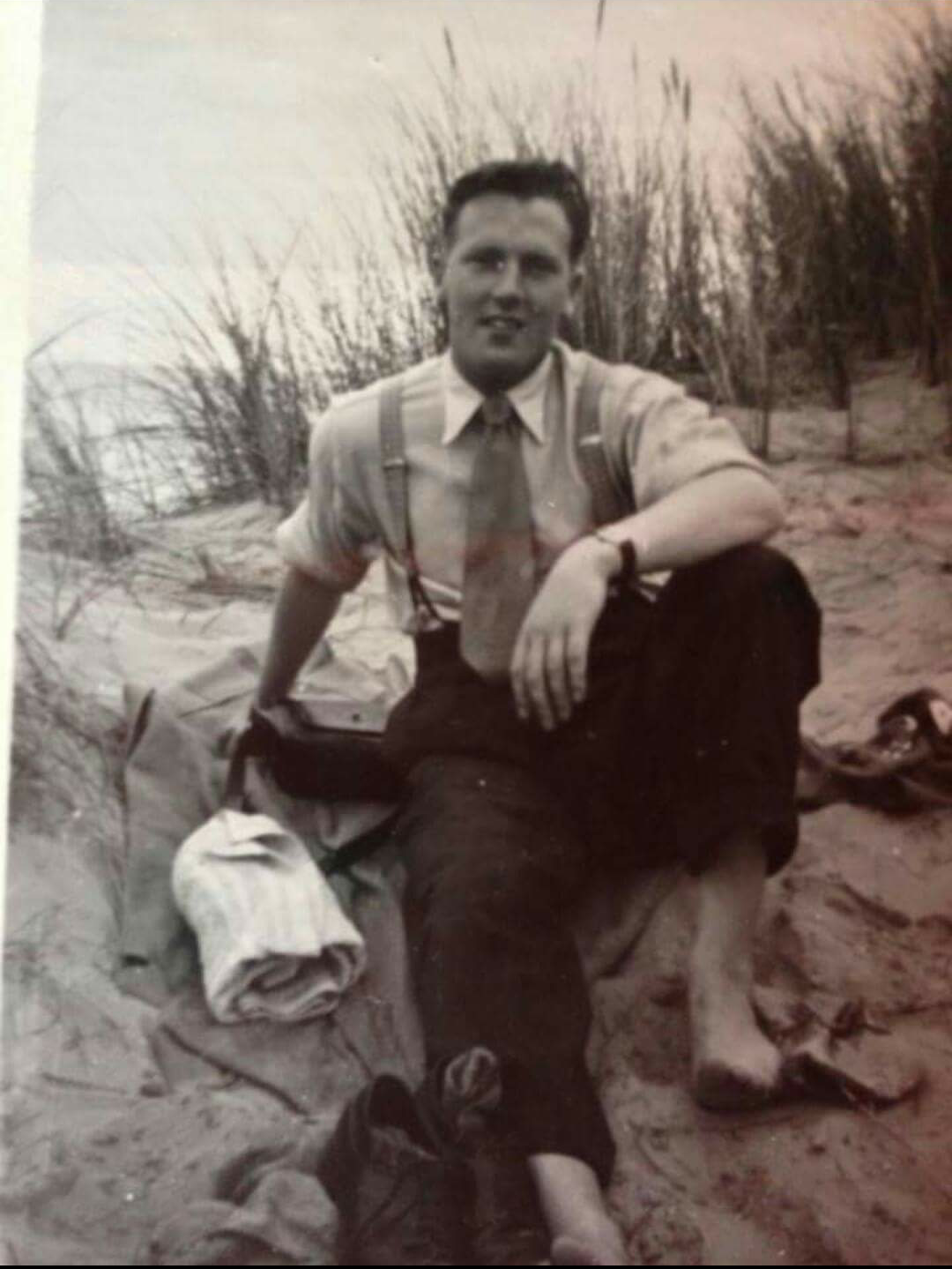
Dad and his sister, Maureen