“I’m the place where relationships crash and sink. I should have my own lighthouse.”
I need a lighthouse
Reply


“I’m the place where relationships crash and sink. I should have my own lighthouse.”
“What’s the new place like?”
“Nice.”
“And the people?”
“Really great.”
“Hmmmmm. Any religious types there?”
“No idea. Why?”
“Just curious, that’s all.”
“We don’t talk about stuff like that. What about your place?”
“Nah. All grand. A few repressed Catholics and the usual smattering of Heathens.”
“The usual?”
“Yeah. The usual. Wasn’t like that in the last place though.”
“Why?”
“We’d a bunch of those Palaeontologists.”
“You had a bunch of what?”
“Palaeontologists. You know them. Real conservative types. Clothes down to the knee and wrist. And up to the neck. Very conservative.”
“And what do they worship?”
“Don’t you mean ‘who’? They worship God.”
“Not dinosaurs?”
“Huh? Dinosaurs? No, God. These Palaeontologists even have their own pope”
“A pope for dinosaurs? Are you sure?”
“What’s with you and dinosaurs???”
“Palaeontologists study dinosaurs.”
“Huh???”
“Eh…You sure you don’t mean Palmarians?”
“Oh…That’s them!”
“Been shopping?”
“Em…yes…” answers the friend as she tries to squash an oddly shaped bag into the seat alongside her.
“Whatcha get?”
She pulls each item out for review…
“A mat for outside my bedroom door so I get into the habit of taking my shoes off…”
“Hmmmm…”
“A breakfast tray for when I find someone to bring me breakfast in bed…”
“Oooooo…”
More rustling and box opening…
“A glass trinket box for my…eh…trinkets.”
“What’s a trinket?”
“No idea!”
“They must have cost a pretty penny.”
“€7.50.”
“You were in Dealz again, weren’t you?!?”
“Yep!”
“What did you go in for?”
“Deodrant…”
“And did you remember to get it?
“Eh…of course not!!!”
“I don’t want to be a doctor. They just trade on people’s illnesses!”
At a Networking event in London: January 2014
Exchange of the night with a guy aiming to run for the Tories in next General Election…
“There aren’t many Protestants left in Southern Ireland.”
“Actually, there are over 100,000 of us.”
“Really? Are you one of them?”
“Yes.”
“But you don’t have the accent.”
“Huh???”
“I thought all Protestants spoke with a Northern Irish Accent…”
I wasn’t wearing my hearing aid tonight in a restaurant and could have sworn the lady seated on the next table said to the waitress: “Please put the sauce on the side of my chlamydia…”
“Yeah. We made up…Grand now. How did it happen? Rain. That’s how it bleedin’ happened. Rain…Wait ‘til I tell ya…Feckin’ eejit was so stubborn. Me Ma offered to collect him from the Bus Stop. But oh no, he wanted to walk. A mile. In the feckin’ rain. So he walked…How did that sort it? I’m getting to that bit…Ended up at the front door – soaked. Me Da told me to give him some dry clothes while Ma dried his. So I did. What did I give him? Took my revenge so I did. Gave him the clothes. He changed and then came in to watch telly with the rest of us…What happened then? There he sat – in between me parents on the couch – wearing me zig zag leggings, me sister’s bleedin’ pink hoody and a pair of me Da’s slippers. He was still sulking but Da was having none of it. Slagged the arse off him about what he was wearing until the miserable bastard cracked a smile. Know he’s a miserable bastard but he’s my miserable bastard!”
3 March 2017
The new revelations about the find of babies’ remains in Tuam, County Galway is beyond vile. While I’ve read a lot of well-meaning comments today, they seem to imply this is at a distance; that it’s history from a by-gone age.
But for me and for so many others, it is so much closer. We were born in Tuam and in places like Tuam. Hearing such news again and again, touches deep into our souls to know our crib mates were treated in such appalling, and often fatal, ways. Some have to deal with news about places they were born. Others wait, wondering will they wake to find their place of birth front page news and have to deal with similar horrors. Many of us remain unaware if we had other siblings and if we did, might they be among those found in Tuam and similar ‘resting places’?
And then there’s ‘survivor’s guilt’ to contend with. I know I’ve felt that from the outset of matters like this beginning to become public in the 1990s. When I watched ‘Dear Daughter’ and saw what happened to girls who were born in the same Home but weren’t adopted or reclaimed, a strange sense of guilt for escaping hit hard.
Commenting on all the news articles is great but in so doing, please be sensitive when posting. It may be at a distance – physically and mentally – for you but for far too many of us, it is very close indeed.
For us, it’s not history. For us, it’s our story.
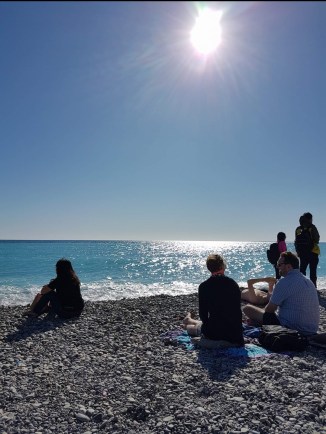
Taking a few days break from the office, I headed to Nice in France. And a lovely break was had. Here are a few observations and encounters…
Day 1
Observations from today…
…the coffee machine in the hotel is a no nonsense gadget with one espresso or two espresso settings…
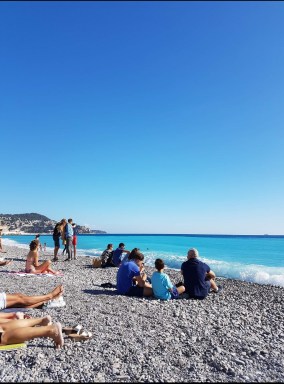
…sitting by the sea in Nice is an expensive business unless you brave the stones…
…children roaring in any language annoy me…
 …there is indeed one gin in the universe I can’t drink…
…four Irish women in frantic search of a corkscrew and paper cups in the afternoon are my tribe…
…people can look out to sea for extraordinary lengths of time without speaking…
…a man out jogging in shorts, no shirt and scratch marks the length of his back is not a good look…
Day 2
Observations from today…
…you can wear a dress back to front for an entire day without noticing…
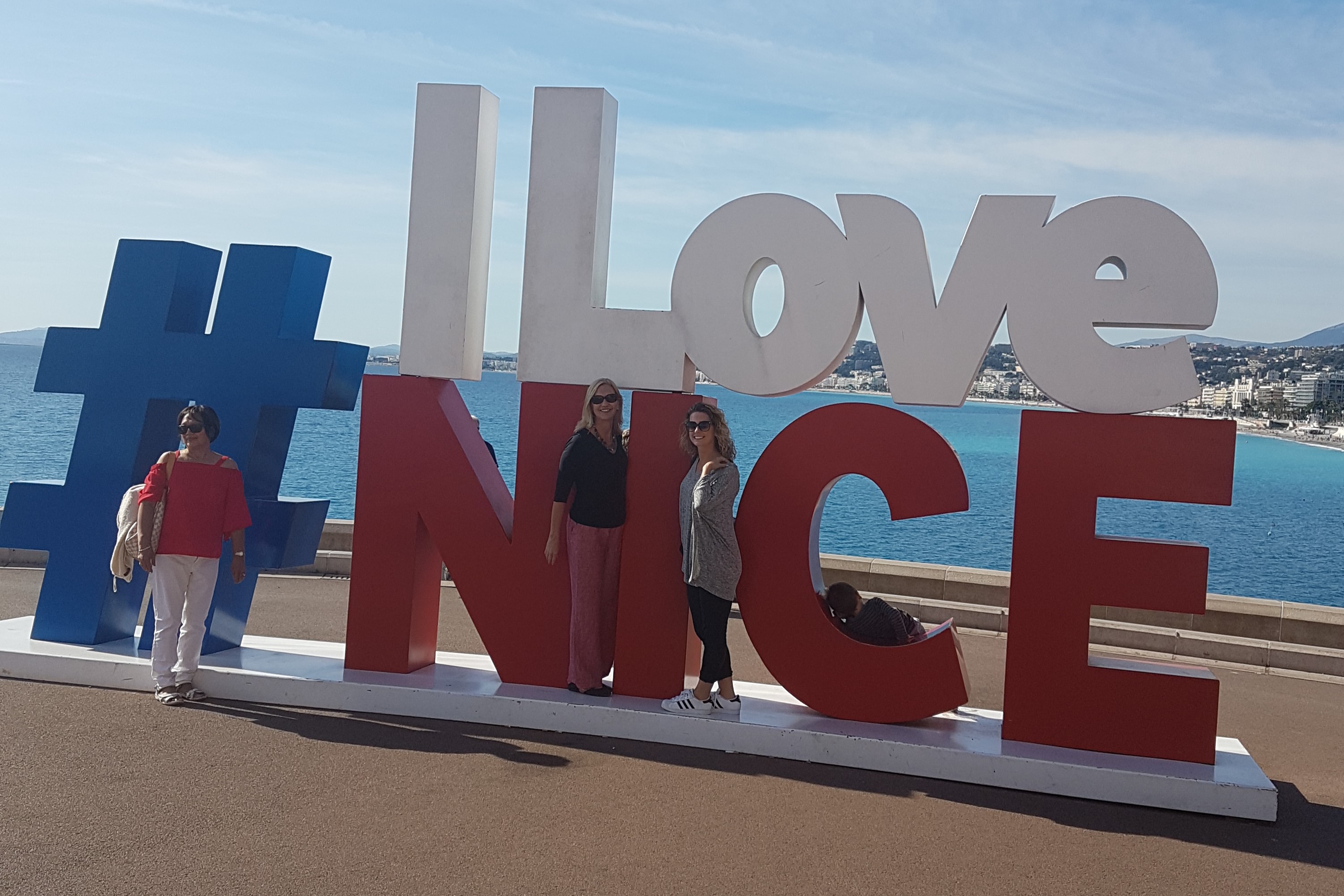
…hearing people say ‘hashtag’ in the middle of whatever language they speak is just plain weird…
 …pedestrian crossings in this town are like an extreme sport – yes, you may cross when the light turns green but I can drive right over your sorry ass if you don’t move quick enough…
…it is possible to get lost on a tram going one way – in a straight line…
…school French comes racing back when there’s coffee/food/ alcohol to be ordered…
Day 3
Today, I headed out of town…
On the local bus to Monaco with four ‘Made in Chelsea’ wannabes who discuss at length how they need a new house for their cats, how well they know Nice, how Monaco is like a second home, how they got ripped off €50 for drugs in a Paris club which turned out to be three Smints, get frustrated when they can’t remember the name of the “ocean” they are looking at, laugh at “how the only way to leave Monaco is drunk and bloodied”, panic look at Google maps “to make sure Monaco is actually in Europe” before getting off the bus about ten stops early…
Observations from today…
…an Irishman roaring “Stick with the system” to his mate sounds as stupid on a street in France as it does on O’Connell Street…
…a man walking straight towards a mirror, and not the exit, is in for a shock…
…an altercation between a Muslim mother and a Jewish couple on the tram is ugly in any language…
…in Nice, I saw yachts bigger than our house…in Monte Carlo, I saw yachts bigger than our estate…
…a Frenchman called ‘Warren’ (‘Oui Warren, War-ren, W-A-R-R-E-N’) has as much difficulty explaining his name to his kinsfolk as ‘Fachtna,’ (‘Yeah, Fachtna, Facht-na, F-A-C-H-T-N-A ‘) to the Irish…
…Monte Carlo has to be one of the prettiest but loudest places I’ve visited in a long time…
‘Sustainability’ and ‘traceability’ are common words used across industry generally. Now they appear prominently in the ‘Slow Fashion’ movement with its emphasis on taking a more accountable approach to manufacturing and purchasing. Stemming from the ‘Slow Food Movement’, it is not about doing everything at a snail’s pace – it is about doing things at the right pace.
Slow Fashion is a spectrum of beliefs, not a hardened set of rules. First coined by Kate Fletcher, Design Consultant, in 2007, it has come to mean different things to many people. At its core, however, it’s an alternative to mass produced clothing, favouring sustainable, ethically produced and recyclable materials which do less damage to the environment than cheaper alternatives. Other elements include opting for clothing from smaller producers, artisans, fair trade outlets, choosing clothing that transcends latest fashion trends and which is repairable plus buying vintage and second-hand clothes when possible. Much of the emphasis is, as Coco Chanel once said, that ‘Fashion fades, style is eternal.’
As a movement, Slow Fashion is gaining momentum. According to Not Just a Label, Slow Fashion represents all things eco, ethical and green in one unified movement. Linking the fashion industry’s output with its impact on the environment, it aims to broaden consumer awareness of the process from material to design to production to delivery. Moreover, it wants to change the consumer’s relationship with clothing. For Maxine Bedat, co-founder of Zady, the question it wants people to ponder is: “How is a product made and what does it mean to me and my values?” The origin and make of a product is essentially what drives the sustainability issue.
Similarly to ‘Slow Food’, Slow Fashion emerged in direct reaction to ‘Fast’ counterpart. In many ways, it is the antithesis of ‘Fast Fashion’ with its negative connotations of often poor grade materials, shabby production values, low wages and questionable business ethics. Instead, Slow Fashion advocates Zady promote ‘No more clothing that ends up on landfills. No more production with questionable roots. Quality over quantity.’
Emphasising quality over quantity, Slow Fashion seeks not only to reduce the number of trends and fashion seasons but to promote the ideal of ‘Less is more’. It is not merely about choosing well-made clothes but ones with longevity, about investing in pieces which will last. Who then is leading the way in Slow Fashion? Some of the brands include Lily Ashwell, Carrie Parry, Pendleton and Zady. Each uses sustainable materials, aiming to design and produce every item in the home country. And in this respect, they pride themselves on relationships with local designers, local producers of fine materials and garments.
Slow Fashion is not necessarily a new departure but rather a return to the old. Over fifty years ago, nearly all clothing was made by home based industries – in the US, that was estimated at 95 per cent ‘but today that number is closer to 2 percent.’ Pendleton, for example, uses mills in north-west America which are over 100 years old to further its commitment to producing homemade materials and garments from sustainable sources. In adopting such styles of production, it aims to reduce water and energy use too.
If rejecting the notion of seasonable fashion, how then will companies launch new collections? In November 2014, Zady announced it will launch a collection of clothes designed and produced entirely in the US – one piece at a time. Doing so, it believes its ‘Essential Collection’ is an extension of the philosophy of sustainable couture.
Slow Fashion is laudable on so many levels but if it seeks to match and then surpass Fast Fashion, it has a rocky road ahead. Despite the emphasis on education and marketing, it is more likely it will be one model of production rather than the only one.
While sitting easy with other movements such as ‘Slow Food’ and ‘Slow Money’, Slow Fashion cannot turn back time to older methods and values if it is to keep pace with need let alone demand. Fashion exists in a very fast paced world where consumer desires are catered for and choice is king. Being built to last is a thing of the past, where short life spans and models mean people have to regularly update – not simply because they have to but because they want to.
Sweatshops and low wages in Asia are often referred to but without proper consideration. If it were indeed possible to raise wages, improve working conditions and use sustainable materials would this meet the philosophy of some ‘Slow Fashion’ advocates? The carbon footprint involved in transporting clothes into western markets would go against the more eco-conscious in this area. Perhaps a slow boat from China might be the way forward…
And in considering transportation from the east might this also impact on Europe to US movement too, curbing home-based Chanel and Dior in how far it might travel? What then of transportation? Some companies deliver within the US only but some do so by air. Discussion needs to occur then on what the limitations of travel should be and if it is indeed feasible without negatively impacting on the industry. In India, for example, if the exporting of clothes was reduced, the effect on the economy would be dramatic – mostly to the cost of the workforce.
Using the best designs, craftspeople and materials also have cost implications and some believe that the cost of Slow Fashion is prohibitive. While Anusha Couttigane, Conlumino analyst, believes marketing, media and education is essential and that eventually sustainable fashion will be available to all, it is a long (long) way from this point. Buying the latest fashion and buying new have cultural implications which cannot be dismissed. Supporters of Slow Fashion may believe education will teach many that less is more and vintage is preferable to always buying new. For many, however, wearing used or repaired clothes – whatever the quality and ethical considerations – is akin to donning hand-me-downs. And hand-me-downs are often what you wear if you cannot afford to buy new. Clothing is intrinsically linked with status and self-image; links the fashion industry has spent billions upon billions seeking to cultivate. There are so many emotional aspects at play here that one can only surmise that it will take more than education to diminish such feelings.
Slow Fashion has much to commend it and it will continue to gain momentum and supporters. Realistically, however, it will not and cannot erase its arch nemesis, Fast Fashion. Here’s hoping that the two can coexist with perhaps the balance being firmly tipped in favour of sustainable and better quality options – at affordable prices.
Published online: 2014
 Thoughts of a Middle Aged Teen